Quebec Winter Carnival 2027: Dates, Passes And What It Is Really Like
A local guide's honest account of the Quebec Winter Carnival: 2027 dates, Effigy pass prices, the Ice Palace, night parades, the ice canoe race, what to wear, and how to pair Carnival with winter tours.
 By Jean-Pierre Tremblay, Quebec City tour guide & heritage specialist
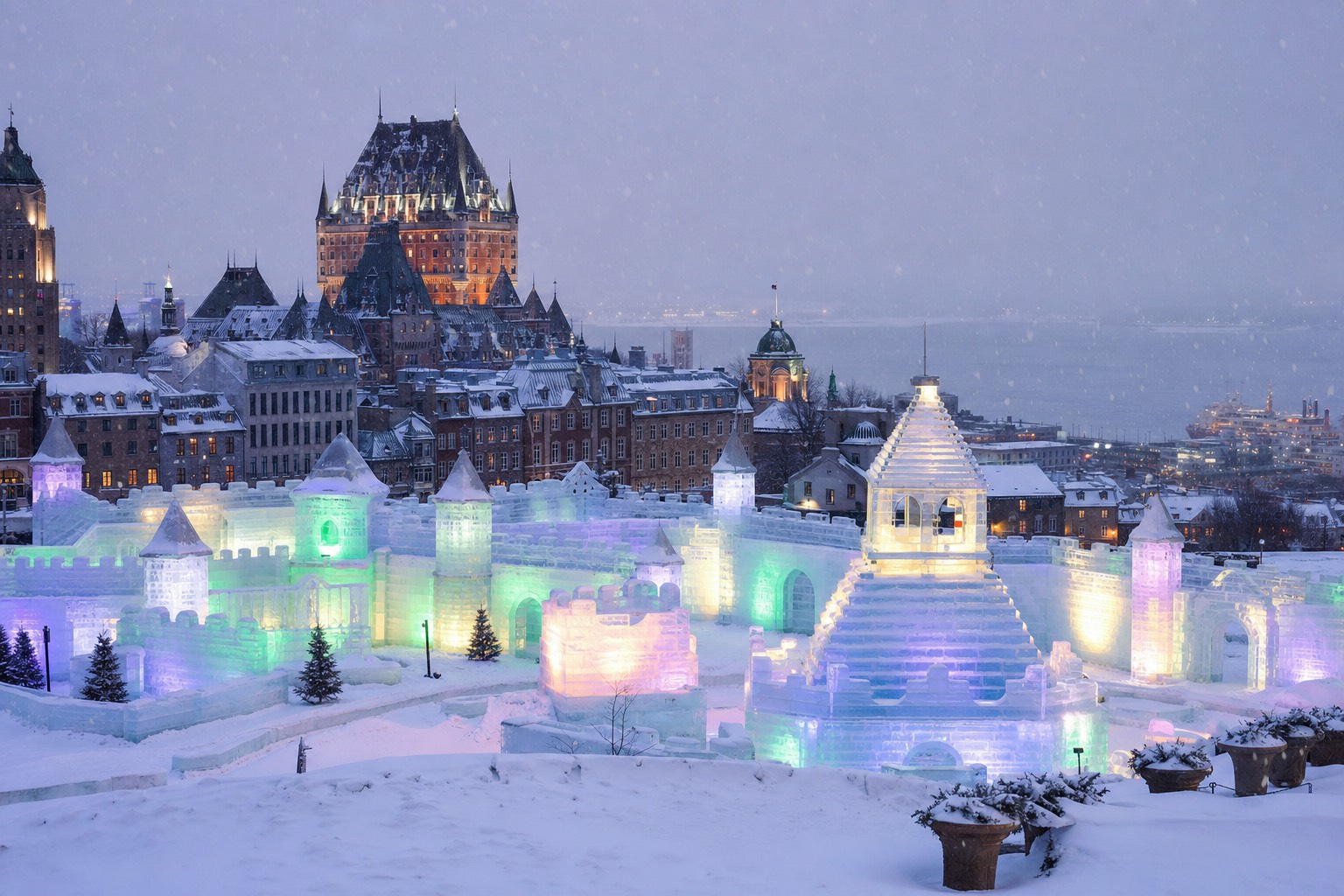
The first thing Carnival changes is the sound of the city. From late January I can hear the chainsaws on Grande Allée, carving blocks the size of refrigerators into swans and voyageurs, and by the opening weekend there are drummers somewhere every night. I have lived through several Carnivals now, guiding by day and walking the site after dark, and I still stop when the Ice Palace lights come on. It glows like something out of a snow globe, except you are standing inside the snow globe, and it is minus eighteen.
That cold is the honest half of the story. Carnival is a joy, and it is also a ten-day endurance event held in the hardest stretch of a Quebec winter. This post covers both halves: what the festival actually is, what it costs, what the parades and the canoe race feel like from the crowd, what to wear so you last past nine o'clock, and how to build the rest of a trip around it.
TL;DR
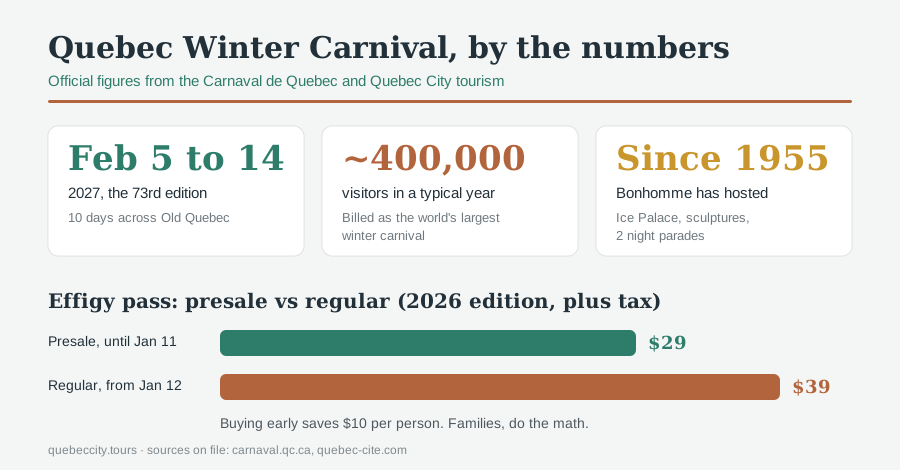
- The 72nd Carnival ran February 6 to 15, 2026. The 73rd is set for February 5 to 14, 2027.
- Entry works on the Effigy pass: $29 plus tax in presale for the 2026 edition, $39 plus tax at regular price.
- The festival draws nearly 400,000 visitors a year. Weekends, parades, and the canoe race are the crush points.
- Dress to stand still outdoors at night, not to walk. Mitts beat gloves, always.
- Daylight hours stay free: the best local pairing is a snowmobile tour on Île d'Orléans, and the whole winter playbook is in my Quebec City in winter guide.
What Is The Quebec Winter Carnival, Exactly?
The Quebec Winter Carnival, Carnaval de Québec, is a roughly ten-day festival held across Old Quebec each February, billed as the largest winter carnival in the world. It brings ice and snow sculptures, Bonhomme's Ice Palace, two night parades, and musical evenings, and it draws nearly 400,000 visitors in a typical year.
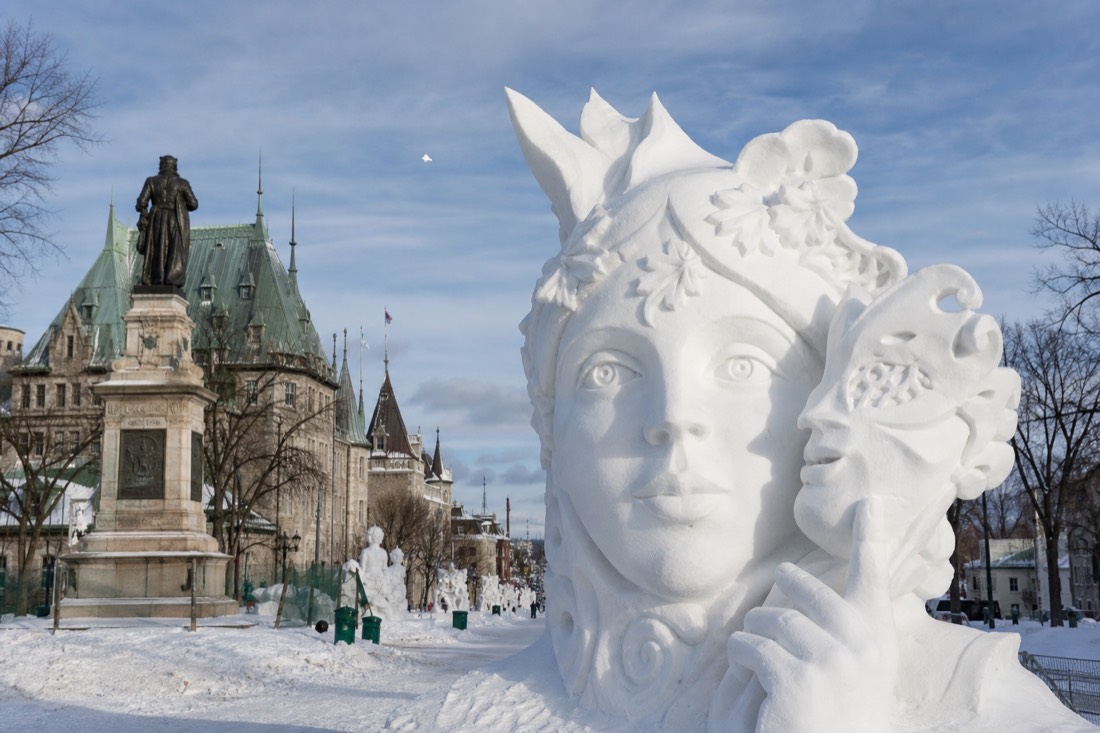
The modern festival dates to 1955, which is also when Bonhomme Carnaval first appeared: the seven-foot snowman in the red tuque and the ceinture fléchée, the woven arrow sash that Quebecers have worn against winter since the fur-trade era. He is not a costumed employee in the way theme-park mascots are. Within the festival's own logic, Bonhomme is the host, the city hands him the keys, and children here treat a sighting the way children elsewhere treat Santa Claus. I have watched grown adults from my tour groups get visibly giddy shaking his mitt.
The footprint spreads across the upper town. Grande Allée and the Plains of Abraham carry the main sites, the Ice Palace rises in front of the parliament most years, and satellite activities spill toward the old city. The full program shifts each edition, so check the official schedule at carnaval.qc.ca before you lock in your dates. What does not shift is the mood: this is the point in the season when the city stops enduring winter and starts showing off with it. If you want the wider event calendar for context, the tourism office keeps its own page on the festival at quebec-cite.com.
When Is Carnival In 2026 And 2027, And What Does The Effigy Cost?
The 72nd edition ran February 6 to 15, 2026. The 73rd Carnival is scheduled for February 5 to 14, 2027. Entry works on the Effigy pass: for the 2026 edition it cost $29 plus tax in presale until January 11, then $39 plus tax from January 12 onward.
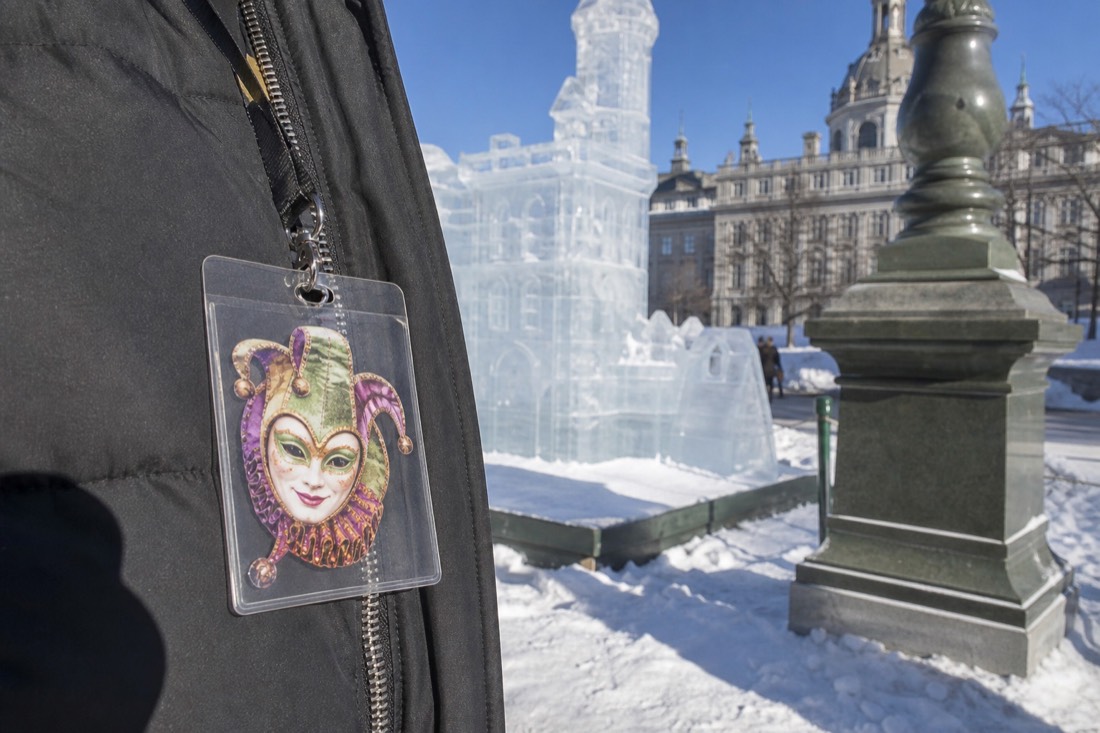
The Effigy is a small Bonhomme figurine you clip to your coat, and it doubles as your site pass for the whole run. Locals collect them by year. Buy it in presale if you can: the 2026 pricing gap was ten dollars per person, which adds up fast for a family, and the presale window closed in early January. Current prices and sale windows are posted on the official Effigy page. Children's admission rules vary by edition, so read the fine print there rather than trusting a blog, including this one.
Here is the planning picture in one table.
| Planning item | The numbers | What to do with them |
|---|---|---|
| 2026 edition (72nd) | February 6 to 15, 2026 | Already run; useful as the template for timing |
| 2027 edition (73rd) | February 5 to 14, 2027 | Book lodging months ahead; both weekends sell out |
| Effigy presale (2026 pricing) | $29 + tax, until January 11, 2026 | Buy before the cutoff announced for the next edition |
| Effigy regular (2026 pricing) | $39 + tax, from January 12, 2026 | The walk-up price once you are in town |
| Annual crowd | Nearly 400,000 visitors | Weekends and parade nights are the crush; weekdays breathe |
| Signature sites | Ice Palace, night parades, sculptures | All at their best after dark, so plan warm afternoons |
What Are The Night Parades, The Ice Palace, And The Canoe Race Actually Like?
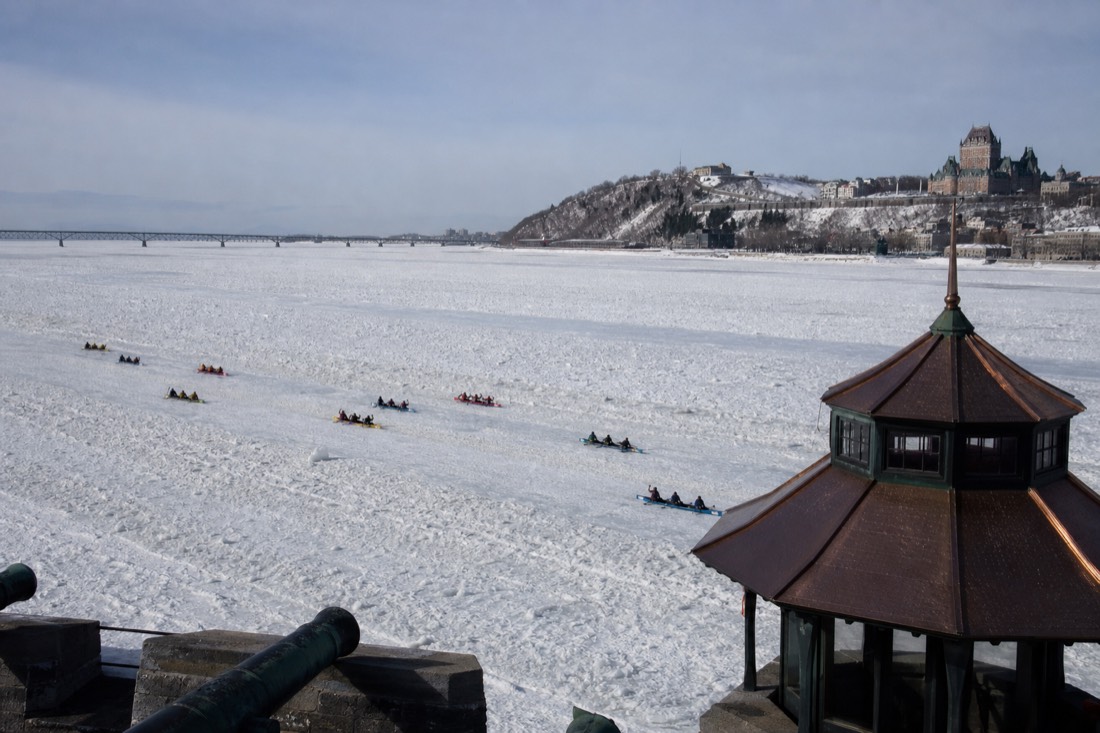
Loud, cold, and better than the photos. The two night parades roll lit floats and drum lines through packed snowbank crowds. The Ice Palace glows from within after dark and rewards a slow walk-through. The ice canoe race sends teams paddling and scrambling across the moving floes of the St. Lawrence.
The parades are the crowd events, and my honest advice is to arrive early or embrace watching over shoulders. Families stake out snowbanks an hour ahead with thermoses and foam mats. The floats are good; the crowd is the show. Strangers pass hand warmers down the line, someone always starts a chant, and the cold becomes a shared joke instead of a problem.
The canoe race is the one I push visitors hardest to see. Teams race across the open channel of the St. Lawrence in special canoes, paddling through slush, then jumping out to drag the boat over pans of ice, then leaping back in before the current takes them. It is a sport born from the real pre-bridge era, when crossing to Lévis in winter meant exactly this. I watch from Dufferin Terrace with coffee, which is also the spot I bring my walking groups for river views in any season. From up there you can hear the scrape of the hulls on the ice.
The Ice Palace deserves twenty unhurried minutes. Go after sunset when the colored lights are on and the walls turn to stained glass. Then reward yourself: the food stalls sell caribou, the hot fortified wine that is Carnival's unofficial fuel, and there is always a queue at the maple taffy on snow.
What Should You Wear To The Quebec Winter Carnival?
Dress for standing still in deep cold, not for walking. That means an insulated parka, winter boots rated far below freezing, thermal base layers, insulated mitts rather than gloves, a real hat, and a neck tube. The headline events run at night, which is exactly when February temperatures fall hardest.
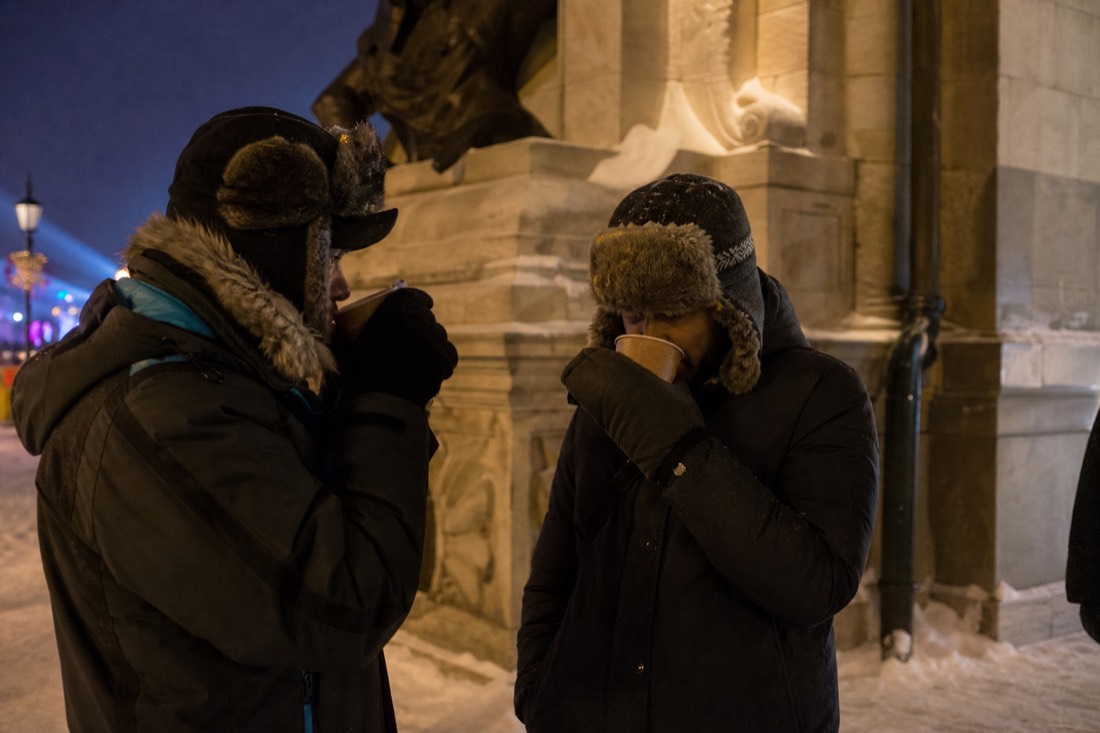
Walking generates heat; parade-watching does not. That distinction is the single biggest mistake I see visitors make. A February day here can sit near minus five in the sun and slide past minus twenty at night with wind, and your outfit has to cover the whole range because Carnival keeps you outside through it.
| Conditions you'll meet | Base and mid layers | Outer layer | Extremities |
|---|---|---|---|
| Sunny afternoon, around -5°C | Thermal top, fleece or wool sweater | Insulated jacket, hood down | Lined gloves fine, warm socks |
| Standard evening, -10 to -15°C | Merino base top and bottom, sweater | True winter parka, hood up | Mitts, tuque, wool socks, winter boots |
| Parade night, -15 to -25°C | Two base layers, insulated mid layer | Parka plus wind-blocking shell if thin | Mitts with liners, neck tube over face, boot insoles, hand warmers |
| Windy riverside (canoe race) | Same as parade night | Zip everything, turn back to the wind | Swap watching spots every 20 minutes, warm up between |
Warming up is part of the rhythm, not an admission of defeat. Locals do Carnival in loops: an hour outside, then a café on Grande Allée, then back out. My own warm-up circuit runs down into Petit Champlain, where the shops double as thawing stations, and the funicular's glass car saves you the climb back up. A lunchtime stop on one of the city's food tours is another honest way to spend ninety indoor minutes eating your way back to feeling in your toes.
How Does Carnival Pair With Winter Tours?
Neatly. Carnival owns the evenings and leaves daylight open. The most local bookable option is a guided snowmobile run on Île d'Orléans, just across the bridge, rated 4.9 from 232 GetYourGuide reviews, from $152. Old Quebec's walking and food tours also run right through winter, snow included.
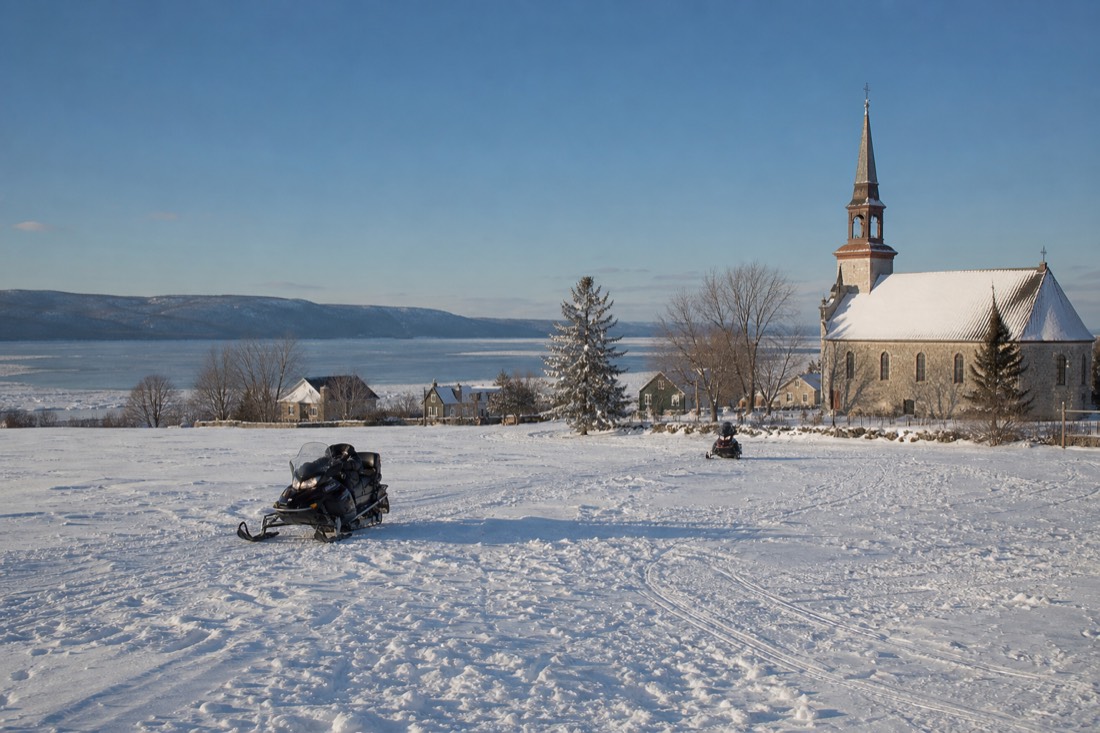
Carnival's program leans hard toward late afternoon and night. That leaves a hole in the middle of your day, and winter here fills it well. The pairing I recommend most is the Île d'Orléans snowmobile tour run by Location Motoneige Québec: you cross the bridge ten minutes from the old city, gear up, and ride the island's fields and sugar-bush lanes with a guide. Reviewers rate it 4.9 across 232 GetYourGuide reviews, and it starts around $152. Compare it against everything else on the winter tours page, and check live availability & prices on GetYourGuide early, because February daylight windows are short and Carnival week compresses demand.
One honesty note, because listings blur geography: the dog-sledding products sold alongside Quebec City tours operate near Mont-Tremblant, roughly 370 km away in the Laurentians. That is a fine activity for a Tremblant trip. It is not a Carnival day activity, whatever the booking platforms imply.
If a snowmobile is too much machine, the daytime alternatives are gentler: a two-hour walking tour of the upper and lower towns looks completely different under snow, the toboggan run on Dufferin Terrace is right there, and the broader list lives in my things to do in Quebec City roundup.
What Does A Carnival Trip Actually Cost Per Person?
The festival is the cheap part. The 2026 Effigy ran $29 plus tax in presale and $39 plus tax at regular price, and that one pass covers the site for the entire run. Lodging, food and daytime activities set your real budget. A guided snowmobile day is the biggest single line at $152.
| Line item | The figure | What it covers |
|---|---|---|
| Effigy, presale (2026 pricing) | $29 plus tax | Site access across the whole ten days |
| Effigy, regular (2026 pricing) | $39 plus tax | Identical access, bought after the presale cutoff |
| Snowmobile day, Île d'Orléans | From $152 | Guided ride, rated 4.9 across 232 GetYourGuide reviews |
| Two-hour walking tour | From $41 | Upper and Lower Town under snow, funicular ride included |
| Evening ghost walk | From $20 | 1h30 on foot after dark, 4.6 across 988 reviews |
| Food tour | From $125 | Ninety-odd indoor minutes and a meal inside them |
| Caribou and maple taffy at the stalls | Price at the stall | Carnival's unofficial fuel, and the taffy queue is permanent |
| Warm-up cafés on Grande Allée | Price of the coffee | Budget three or four across a full Carnival day |
| Lodging in Carnival week | Seasonal rates | Both weekends fill; this is the line that hurts |
Tour prices are from-figures on the listings. Effigy pricing above is the 2026 edition; check the official shop for the current edition before you assume it repeats.
The presale gap is the easiest ten dollars anyone saves on this trip. For a family of four that is forty dollars, which is a round of caribou and taffy for everyone, and the only cost is remembering to buy in early January rather than at the gate. I have never met a local who pays the regular price.
Everything else scales with how much daylight you fill. A Carnival day that runs late afternoon to late evening, with a café stop in the middle, can genuinely cost the price of the pass plus dinner. A Carnival day with a snowmobile morning attached is a different order of trip. Both are legitimate. What is not legitimate is booking the expensive daytime option for all three of your days, because the cold takes more out of you than the schedule suggests, and something on day three will get skipped.
When Is The Carnival Site Busiest, And When Does It Breathe?
Weekends and parade nights are the crush. Nearly 400,000 visitors across a ten-day run averages roughly 40,000 a day, and they are nowhere near evenly spread. Weekday afternoons are the quiet window, weekday evenings are the sweet spot, and the canoe race concentrates a whole day's crowd on one stretch of riverbank.
| Moment in the run | How it feels | My move |
|---|---|---|
| Opening weekend | Peak everything, the whole city turns out | Come for the atmosphere, not for photographs of sculptures |
| Either Saturday | Dense from mid-afternoon onward | Site early, dinner late, skip the headline queue |
| Parade nights | Snowbanks claimed an hour ahead | Arrive early with a foam mat, or accept watching over shoulders |
| Ice canoe race | One riverbank, one window, everyone there | Watch from Dufferin Terrace instead of fighting for the front |
| Weekday afternoons | The site actually breathes | Ice Palace and sculptures without a queue in front of them |
| Weekday evenings | Lit, atmospheric, walkable | The best value hours of the whole festival |
| Final days | Busy again as the run closes | Treat like a weekend, whatever the calendar says |
The arithmetic above is the useful part. Ten days, nearly 400,000 people, and a program that leans hard toward late afternoon and night means the crowd is compressed into perhaps five hours of each day and concentrated further onto four or five of those days. Show up on a Tuesday at four in the afternoon and you are walking through the same site that will be shoulder to shoulder on Saturday at eight.
Where you stand matters as much as when. The parades are a linear event, so the crowd is thickest at the obvious corners and thins noticeably a few hundred metres along the route. The canoe race is the opposite: a single visual event across the river, which is exactly why the Terrace works. From up there you get elevation, a coffee within reach, and the sound of the hulls scraping ice without anybody's shoulder in your frame.
Locals treat the whole thing as a loop rather than a marathon, which is the other half of crowd management. An hour outside, a café, then back out. Nobody stands in the cold for four straight hours except visitors trying to get their money's worth from a pass that already covered the whole ten days.
Who Should Skip The Quebec Winter Carnival?
Anyone without real winter clothing, anyone whose ideal trip is a quiet old town, and anyone hoping to book their whole February around it on short notice. Carnival is loud, outdoor and deeply cold by design. December delivers the same city with markets and lights instead of parades.
| If this is you | Why Carnival may not fit | The better move |
|---|---|---|
| No parka, no winter boots | The headline events run at night, standing still, well below freezing | Buy the kit or move the trip to December |
| You want quiet, atmospheric streets | Ten days of programming, parades and crowds in the upper town | Christmas in Quebec City is the same city at strolling pace |
| Crowds ruin an evening for you | Weekends and parade nights are genuinely dense | Come midweek only, or come outside the run entirely |
| Very young children with early bedtimes | The best of the festival happens after dark | Early evening only, then a December trip instead |
| You booked late and lodging looks brutal | Both weekends fill and rates follow | Weekday nights, or a different February week |
| You came for dog sledding | Those products run near Mont-Tremblant, roughly 370 km away | Book the Île d'Orléans snowmobile run instead, ten minutes over the bridge |
None of that is a reason to avoid February in this city. It is a reason to be honest with yourself about which February you want. The month-by-month case sits in the best time to visit Quebec City guide, and the wider cold-weather playbook is in Quebec City in winter.
I say this to visitors on the Terrace every year and it lands the same way: Carnival is not the only good winter here, it is the loudest one. The city is beautiful under snow on an ordinary Wednesday in January, with nobody on Grande Allée and the walls white to the top. If the program is not what you came for, come for that instead.
Should You Visit For Carnival Or For The Christmas Season?
Pick Carnival for events, Christmas for atmosphere. Carnival is a ten-day program of parades, races, and the Ice Palace in the coldest part of winter. December trades that program for markets, lights, and quieter streets in usually milder cold. Both periods fill hotels, and both demand real winter clothing.
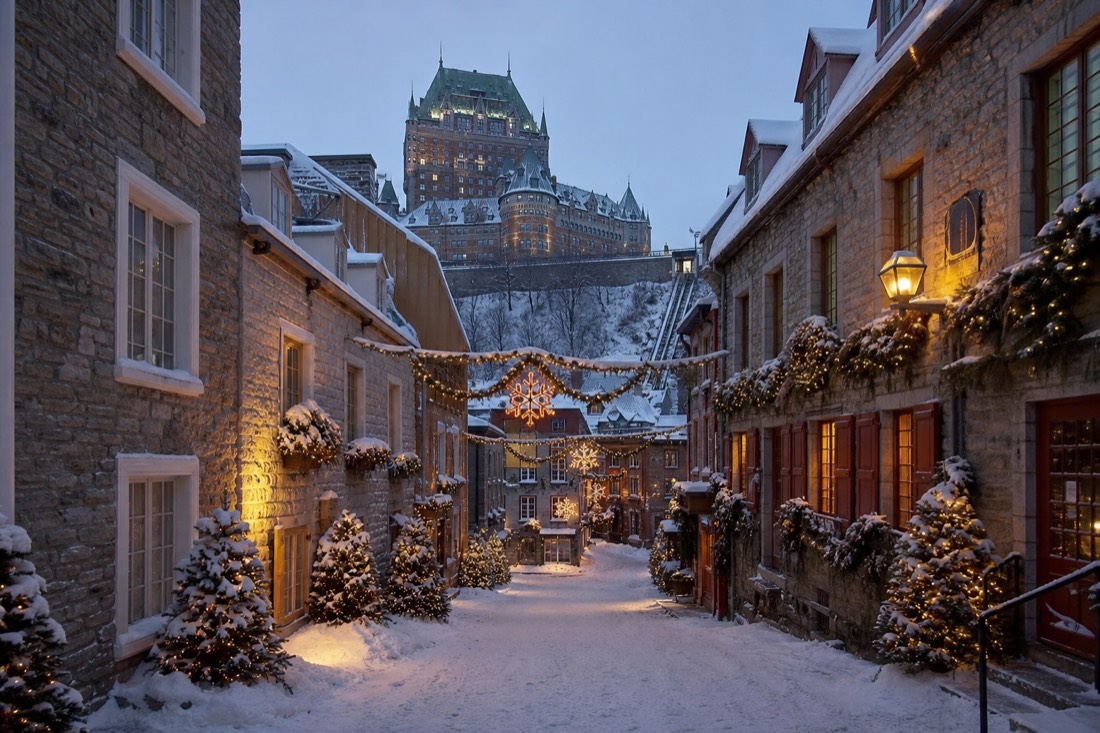
I get this question from visitors more than almost any other winter question, and the honest answer is that they are different trips wearing the same mittens.
| Carnival (February) | Christmas season (December) | |
|---|---|---|
| What's on | Parades, canoe race, Ice Palace, sculptures, full nightly program | Markets, lights, decorated Petit Champlain, holiday concerts |
| The cold | The deepest of the year; plan for -15°C and below at night | Cold but usually gentler; snow cover less guaranteed early on |
| Crowds and booking | Nearly 400,000 visitors across the run; both weekends spike | Busy weekends, then a quiet lull in early December |
| Energy | Loud, communal, outdoors after dark | Intimate, strolling-paced, storefront-glow romantic |
| Best for | Families who want a program, festival lovers, sports watchers | Couples, photographers, market browsers |
| Pairs with | Snowmobile and daytime winter tours | Shopping, museums, long dinners |
If your heart is set on twinkle lights and mulled wine among the decorations, I wrote up that season separately in Christmas in Quebec City. If you are still weighing winter against the rest of the calendar entirely, the month-by-month case is in the best time to visit Quebec City guide.
My last piece of advice is the one I give every February group: do not try to do all ten days. Pick three, one of them a weekday, sleep in, and be outside from late afternoon until the cold wins. Carnival is not a checklist. It is a city deciding, for ten days in its hardest month, to throw a party in the snow, and the best thing you can do is dress well enough to stay at it.
Your Next Step
Choose Your Quebec Experience
General recommendation, before you add preferences. Confirm dates and participation requirements with the operator.
Have your travel date in mind? Explore the snowy forest with a guide, snowshoe equipment, round-trip transport and lunch included. Check the departure before arranging the rest of your day.
6 hours overall, including the journey. This is an active winter excursion; check the conditions and participation requirements.
Departure schedule from Viator; final availability and price are confirmed on Viator.
Compare Options And Fit Your Plans
Explore the snowy forest with a guide, snowshoe equipment, round-trip transport and lunch included. 6 hours overall, including the journey. This is an active winter excursion; check the conditions and participation requirements.
Taste poutine, pea soup and maple treats across a guided Old Quebec food walk. 3 hours, English guide. Menus can change; dietary substitutions require advance confirmation.
Follow a guide across the island’s winter landscape with helmet and winter gear supplied. 90-minute ride, plus preparation and your own transport to 186 Côte Lafleur. Allow 4 hours from Quebec City. Drivers must be 18+ with a licence; passengers 9+. Two riders share a machine; physical restrictions apply.
Explore Old Quebec’s holiday atmosphere with a guide in period costume and a small hot chocolate. 2 hours on foot. Book for the festive season; the walk does not include a Christmas Market ticket because the market is free.
Affiliate links: we may earn a commission at no extra cost to you.